Presupuestos
Digital Signatures on Construction Estimates: Legal, Secure, and Faster to Close
For years, the paper signature was the only way to formalize an agreement with a construction client. You'd print the estimate, bring it to the site or mail it, wait for the cli…
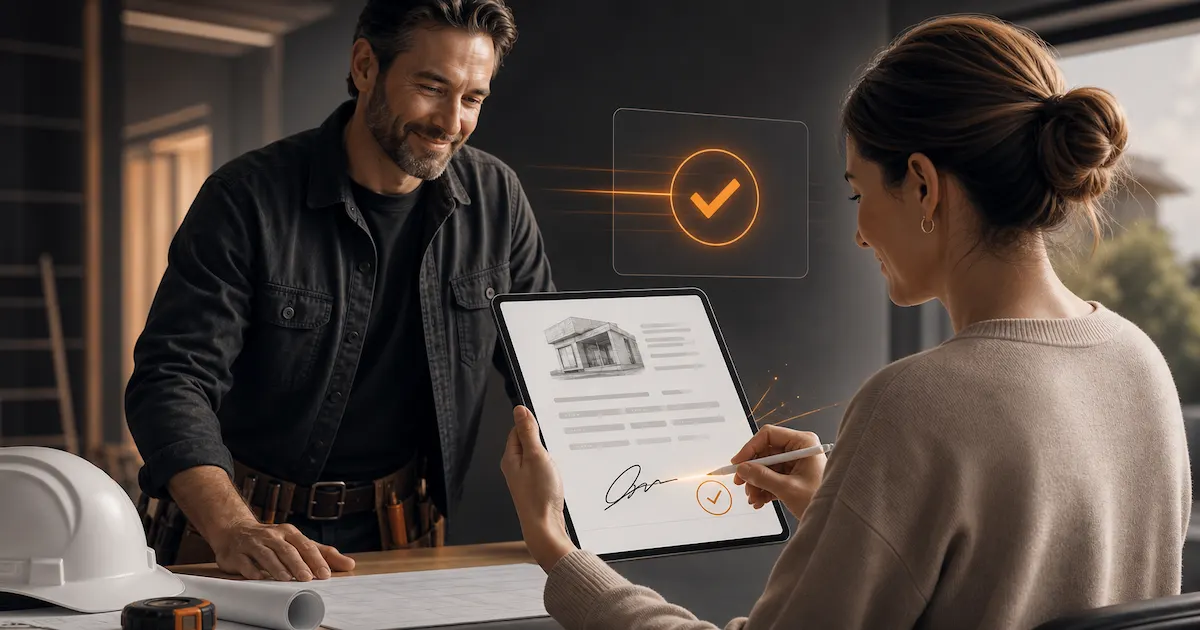
For years, the paper signature was the only way to formalize an agreement with a construction client. You'd print the estimate, bring it to the site or mail it, wait for the client to sign and return it. Best case, a few days. Worst case, the job hung in limbo while paper traveled back and forth.
Electronic signatures solve this completely. And the most important thing: they are fully legal under U.S. and federal law, and in many cases harder to dispute than a handwritten signature.
What U.S. Law Says About Electronic Signatures
In the United States, electronic signatures are governed by two key laws:
The ESIGN Act (Electronic Signatures in Global and National Commerce Act, 2000): federal law that gives e-signatures the same legal standing as handwritten signatures for most commercial contracts, including construction agreements.
UETA (Uniform Electronic Transactions Act): adopted by 47 states, provides a legal framework at the state level consistent with ESIGN.
For a standard construction estimate or contract, an electronic signature — whether a typed name, a checkbox, a drawn signature, or a click — is fully enforceable in court. The legal threshold is simply that both parties consented to conduct business electronically and the signature is attributed to the signatory.
When you need airtight legal protection, platforms that include an audit trail (timestamp, IP address, email of signatory, document fingerprint) produce evidence that's harder to contest than most paper signatures.
What the Client Experience Looks Like
The flow is simple:
You send the estimate to the client as a link.
The client opens it on their phone or computer.
They draw a signature with their finger or click to accept.
You receive an instant notification with a timestamp.
The estimate is locked and the agreement is confirmed.
The whole process can take under five minutes from the moment the client opens the link. No printing, no scanning, no email attachments lost in the spam folder.
Why E-Signatures Close More Jobs
The time between sending an estimate and getting confirmation is your highest-risk window. Every day that passes is an opportunity for the client to second-guess, get a competing bid, or simply let inertia take over.
E-signatures compress that window. When the client can sign wherever they are, in the moment they decide, the friction disappears.
Research on service-based sales consistently shows that reducing the steps required to say "yes" increases close rates. In construction, where the client decision already involves significant cost and disruption, removing extra paperwork is critical.
When E-Signatures Are Especially Valuable
Remote property owners: if the client lives out of state and the job is at a vacation or investment property, asking for a paper signature is a logistical problem. E-signature closes it immediately.
Emergency or urgent projects: when you need to start fast, you can't wait three days for paper. An electronic signature lets you begin the next morning.
High-value jobs where you need maximum protection: larger jobs are exactly where you want the most solid paper trail. An e-signed document with a complete audit trail is stronger evidence than a handshake or even a physically signed document that could be claimed as forged.
E-Signature vs. "I'll Text You Yes"
Many contractors operate on text message acceptance — the client replies "go ahead" and that's the green light. Technically this may create an implied contract, but it has real limitations in a dispute: the client can claim they misunderstood the scope, that the price wasn't what they expected, or that they were approving something else.
An electronic signature on the full estimate document creates a clear record: the client reviewed the complete document and consented. With timestamp and audit trail, it's nearly impossible to credibly dispute.
How Digital Signatures Work in Presupix
In Presupix, the digital signature is built directly into the estimate flow. When you share the estimate link:
- The client gets a unique URL.
- They can review the full document on any device.
- They sign with a finger or click to confirm.
- The document is recorded in the job history with date and status "Accepted."
No third-party subscription needed. The signature is part of the estimate.
Digital signatures on construction estimates aren't future technology — they're a practical tool already used by thousands of contractors to close faster, protect themselves legally, and look more professional. If you're still waiting for paper signatures, you're leaving time and jobs on the table.
Frequently asked questions
Are digital signatures legal on construction estimates in the U.S.?
Yes. The federal ESIGN Act gives e-signatures the same legal standing as handwritten signatures for most commercial contracts, and UETA, adopted by 47 states, provides a consistent legal framework at the state level.
How does a client sign a construction estimate from their phone?
You send the estimate as a link, the client opens it on their phone or computer, draws a signature with a finger or clicks to accept, and you receive an instant notification with a timestamp. The whole process can take under five minutes.
How is an e-signature different from texting "yes"?
A text reply may create an implied contract, but the client can later claim they misunderstood the scope or price. An e-signature on the full estimate document, with a timestamp and audit trail, creates a clear record that's much harder to dispute.
When are digital signatures especially useful?
For remote property owners who live out of state, urgent projects where you need to start the next day, and high-value jobs where you want the strongest possible paper trail with a complete audit trail.